

A few months ago, I started writing a blog about land acknowledgements because I heard someone say they were tired of them. And yeah, I admit sometimes they are seemingly repetitive and somewhat performative. I was even at an event where someone next to me said, “you’d think we said it enough”.
At the time, I thought maybe we are misunderstanding what a first step is supposed to do. I think somehow people figured that the first step was supposed to get you all the way there. I mean they were right that it was supposed to move you, but definitely not something that got you to the finish line.
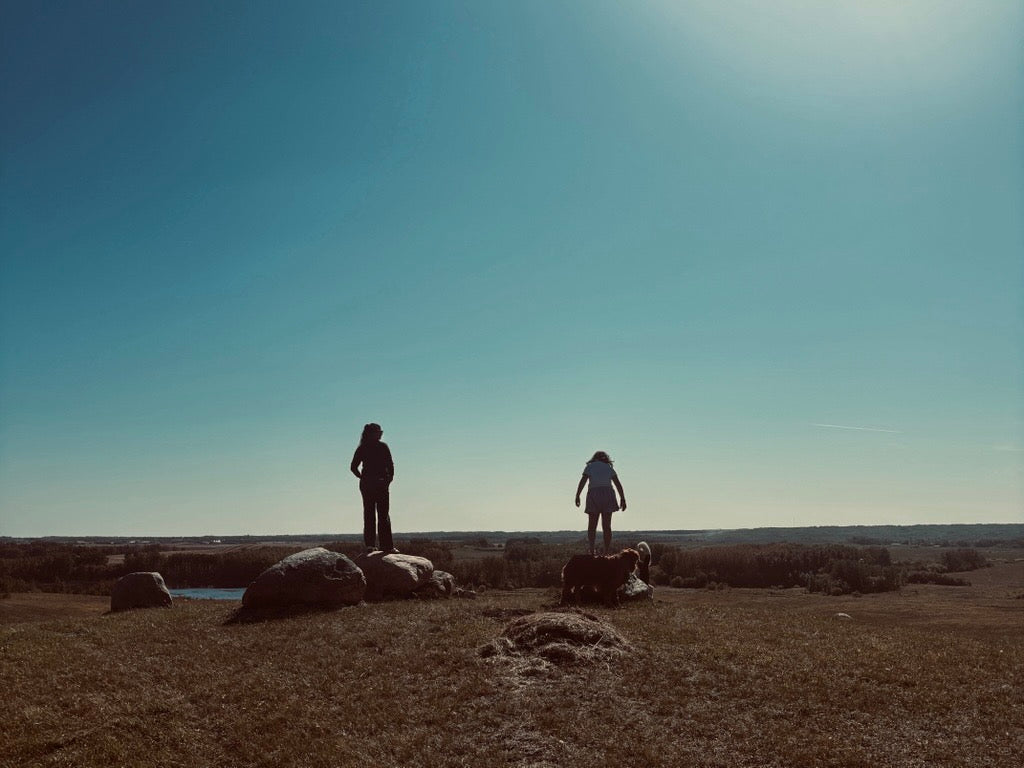
I was recently standing on my rock on the hill (the rez, in the field at my parents place), lamenting at the fact I felt inadequate on what I had learned about business and feeling a bit down about not learning fast enough. I was reminded of the idea of stepping stones and actually, my dad gifted me a rock for my pocket. Kind of like a lucky rock, but also a little piece of home to carry, and mostly a reminder of this concept of stepping stones. As I took it from my pocket I thought about the ground our ancestors walked before us, the same ground we are walking now, and the little pieces of solid ground we are trying to leave behind for the people who will come after us.
This summer, we marked 150 years since Treaty 6 was signed.
I am a nehiyaw iskwew, a Cree woman, born and raised on Treaty 6 territory. A free-range rez kid connected to my home, my family, my culture and raised by some really strong people.
For me, I never thought of Treaty as history or something that happened 150 years ago and ended; it is a relationship I was born into and I was reminded of this every June when I would collect my $5 treaty money (and sometimes give it to my kokum for rabbit snares).
This year, marking 150 years, made me think about how far we have travelled within that relationship, and how far we still have to go. This practice of reflecting on the timeline I was born into helps to remind me of my responsibilities; I wrote this blog because maybe you too will see yourself in it.
In efforts to keep this short, I’ll summarize the origin of the issue; before Alberta or even Canada ever existed, our Nations were here on this land. We had laws, languages, economies, systems of governance, ceremony and ways of caring for one another. But then came the policies designed to dismantle those systems.
Treaty No.6 was entered into in 1876; that same year, the Indian Act became law, children were taken to residential schools, ceremonies were outlawed, families were separated, languages were attacked, and ultimately, Indigenous peoples were pushed out of economies being built on the lands we had always lived upon. And still, we kept surviving.
In 1960, First Nations people gained the federal vote without having to give up their status.
In 1982, existing Aboriginal and treaty rights were recognized and affirmed in Canada's Constitution, Section 35.
In 1996, the last federally operated residential school closed.
In 2008, Canada formally apologized to former students of residential schools, evidently, it was the first time the harms were acknowledged by the Federal government.
In 2015, the Truth and Reconciliation Commission released its 94 Calls to Action.
None of those moments fixed everything, but I saw them as stepping stones and I think that matters, because history can often look like a list of dates when really, it’s more like a trail left by people who endured so much and still pushed for change. In my mind, I imagine the trail of our own people adding to this timeline. It includes every person who kept speaking the language, every kokum who kept a teaching alive, every leader who entered a room that wasn't designed for us, every Indigenous student who walked onto a university campus, every entrepreneur who started a business. Every person who just believed that they could; every person who put down another stone.
I felt one of those stones beneath my own feet in 2016. It was back when I was a Commerce student when I heard Murray Sinclair speak at the closing of the Truth and Reconciliation Commission’s 5 year journey of gathering testimonials and truths from survivors and their families on the harms of the residential school system.
His words about walking tall and singing loud stayed with me; they made me think about what could be possible if Indigenous people weren't only fighting to survive systems that excluded us, but were entering them, changing them and building something new.
I graduated university 2018, in the first generation of my family not in residential schools
In2021, we launched Indigenous Box.
Also in 2021, over 200 potential child burial sites were discovered at the former Kamloops Indian Residential School
This past weekend, just days before the National Day for Truth and Reconciliation, masked individuals associated with a white-nationalist group gathered on Tk'emlúps te Secwépemc territory near the former Kamloops Indian Residential School. Later, a banner appeared asking, "Got bones?"
When I’m reminded of all the hate that still exists towards us, it’s heavy. So I have to remind myself that progress isn't a straight line. I have to focus on the things I can do.
For me, I focus on Indigenous Box. And just serving our mission.
At the beginning, I didn't know what I was doing. I don't think most entrepreneurs do, really. So you control what you can. You take one step, and then another. You learn something, make a mistake, adjust and you find another piece of solid ground. Eventually, you turn around and realize you have made a path.
And because of that, I have grown with it. Or maybe it’s the other way around.
And ’ve learned that entrepreneurship is about responsibility. When you build something in community, your decisions rarely belong only to you; you carry employees, suppliers, customers and families whose products sit on your shelves and a lot of the time, you carry the responsibility of being the Indigenous person in the room who knows the opportunity in front of you needs to become an opportunity for someone else too.
I am still learning where to put my feet. But I understand the responsibility differently now. And I think I understand reconciliation differently too.
Five years ago, the findings at that former residential school forced this country to look again at a history Indigenous families have carried for generations and now to see those words matched with those actions, it reminded me that moving forward doesn't mean we can never move backward. People will challenge progress, they will challenge our truths and memory but this is exactly why we have to keep walking. Our responsibility is not to finish the path we inherited, but more to move forward and leave the next stepping stone.
That perspective or reflection changes how I think about being a community member, how I think about entrepreneurship and leadership, and, ultimately, how I think about reconciliation. So I will keep going forward. I will use the stepping stones that were laid by people before me. And I will look for places to leave stepping stones of my own.
This September 30, I will still acknowledge that I live, work and build on Treaty 6 territory, my home territory.
I will still wear orange.
I will still talk about residential schools and Treaty.
All of these things are the markers along the path that we inherited. The acknowledging matters.
Because, I believe acknowledgement will lead to learning, learning will lead to relationship, relationship will lead to responsibility, responsibility will lead to action and action will create the space for you to leave something behind for the next person to stand on.
None of us will achieve reconciliation on our own, but we can put down stepping stones, and to acknowledge the people who walked long and far to leave stones for us. It’s our responsibility to do the same.
Years ago, late Murray Sinclair's words taught me to walk tall and sing loud. I understand those words differently today; I think that walking tall means having enough courage to step onto new ground and singing loud means making sure the people coming behind us can hear where the path is.
So, I'll keep walking, building, taking chances, learning my way through and when I find solid ground, I will do my best to leave a stone behind.
So that someone else can take the next step.


1 comment
Annie Belec
I would love to have a link to the blog as I continue my journey of learning about the culture and its journey
Leave a comment
This site is protected by hCaptcha and the hCaptcha Privacy Policy and Terms of Service apply.